
El Niño and Your Yard: How Wetter Weather Can Lead to Drainage and Erosion Problems in North Georgia
El Niño can favor wetter winter conditions across parts of Georgia, putting extra pressure on yards that already struggle with runoff, standing water, or soil erosion. The risk depends on your property’s soil, slope, drainage routes, and the storms that actually arrive—not the climate pattern alone. Understanding those connections helps you choose drainage & erosion solutions that address the cause rather than repeatedly repairing the damage. (weather.gov).
How does El Niño affect drainage in North Georgia?
El Niño changes tropical Pacific ocean temperatures and atmospheric circulation, which can shift the jet stream and influence storm tracks across the southern United States. Its effects are generally more apparent during winter, and portions of Georgia can experience wetter conditions. However, the typical wet signal is stronger in southern Georgia; North Georgia should not be treated as guaranteed to receive excessive rainfall during every El Niño.
For homeowners, rainfall intensity and existing soil moisture matter more than the seasonal label. Heavy rain can exceed the ground’s ability to absorb water, while saturated soil can generate runoff during additional rainfall. That is why a yard may handle an isolated shower but struggle when storms arrive before the ground has recovered.
Think of El Niño as a reason to review drainage—not a diagnosis. No single storm can be attributed to the climate pattern alone, and seasonal tendencies do not replace local forecasts or flood warnings. Preparing for El Niño drainage and erosion problems in North Georgia starts with understanding your particular yard.
Why some yards struggle more than others
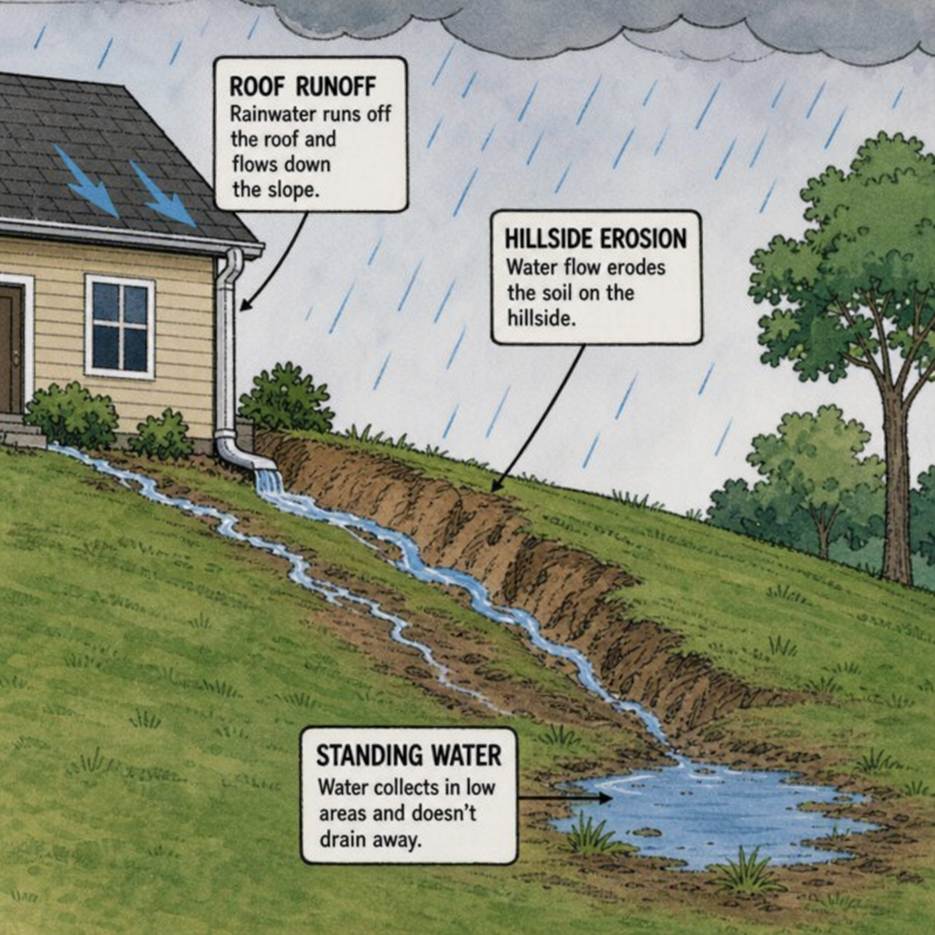
Two neighboring properties can respond very differently to the same rainfall. Soil texture, compaction, grading, and surface cover all influence whether water soaks in, collects, or moves downhill. A steep yard may shed water quickly yet suffer erosion, while a flatter property may hold water in shallow depressions. (extension.okstate.edu)
Clay-rich soil can absorb water slowly, but clay is not the only issue. Construction traffic, repeated foot traffic, and equipment can compress soil and reduce the pore spaces that carry water and air. Compacted areas may develop ponding on level ground or increased runoff on slopes. Keeping vehicles and heavy equipment off wet ground helps avoid making that condition worse. (nrcs.usda.gov)
Roofs, driveways, and other hard surfaces also change the equation. Instead of absorbing rain, they send water toward another location, sometimes concentrating it at a downspout outlet or pavement edge. Redirecting suitable roof runoff to a properly located landscaped area can reduce runoff, but sending it toward a foundation or another problem spot simply relocates the trouble. (epa.gov)
What are the warning signs of drainage and erosion problems?
Warning signs include recurring puddles, water moving toward buildings, soil washing downhill, and sediment collecting where runoff slows. These clues help distinguish water that cannot escape from water that is escaping too forcefully. The distinction matters because drainage and erosion problems often need coordinated repairs rather than the same treatment everywhere.
During the next rainfall, observe from a safe, sheltered location. After conditions are safe, photograph the affected areas and record what changed. Use this checklist to organize your observations:
- Repeated ponding: Note the location, approximate extent, and how long water remains after rainfall ends. Recurring low spots deserve closer evaluation.
- Runoff toward the house: Watch for downspout discharge or surface flow heading toward foundations, basement entrances, or crawlspace openings.
- Small channels in soil: Follow these uphill to identify where water begins concentrating rather than treating only the lowest damaged spot.
- Sediment deposits: Soil collected on a walkway, driveway, or lower lawn can reveal erosion farther upslope.
- Exposed roots or displaced mulch: These may show where surface material is being carried away repeatedly. (cmg.extension.colostate.edu)
Keep the observations specific. “Water crosses the walkway from the uphill bed before reaching the lawn” gives a drainage professional more to investigate than “the backyard floods.” A simple sketch showing buildings, downspouts, slopes, and wet areas can make the eventual conversation more productive.
Do not enter moving floodwater to investigate. North Georgia flooding can involve hazards beyond an ordinary soggy lawn, and the National Weather Service advises against walking or driving through flooded areas. Keep children away from culverts and storm drains during flooding. (weather.gov)
Which drainage solutions fit your yard’s problem?
The right drainage solutions depend on where water originates, whether it travels across the surface or through soil, and where it can safely go. Start by identifying those pathways before selecting a pipe, trench, or landscape feature. A successful repair needs an appropriate destination for water—not merely a way to collect it. (cmg.extension.colostate.edu)
Manage roof runoff first
Check where every downspout releases water. Where conditions allow, redirecting runoff from pavement into a suitable lawn or planted area can give it an opportunity to soak in. The receiving area must be appropriate for that extra water, and the route should avoid creating unsafe conditions or property damage. (epa.gov)
Follow the entire proposed route rather than stopping at the end of an extension. A discharge point that looks harmless during light rain may still need an overflow plan during a larger storm. Rain barrels can provide temporary storage, but they are one part of runoff management rather than a complete drainage system.
Correct surface flow and low spots
When water collects because of grading, changing the surface route may be more useful than immediately installing an underground drain. Depending on the site, correcting a depression or creating a shallow, vegetated swale can guide water toward an appropriate receiving area. The work should preserve drainage away from buildings and avoid transferring the problem to a neighboring yard. (yardandgarden.extension.iastate.edu)
Avoid filling a wet spot without considering the surrounding elevations. Raising one patch may create a new low point beside it or change the direction of runoff. Before approving grading work, ask for an explanation of the complete flow path, including where water will travel during heavier rainfall. (cmg.extension.colostate.edu)
Use French drains selectively
A French drain typically consists of a gravel-filled trench, often containing pipe, that collects and conveys water. It can help in appropriate locations, but it needs a suitable slope and outlet. Installing one simply because an area is wet skips the important step of determining why the water is there.
Ask the the experts what the drain is intended to collect, where it will discharge, and how the system will remain accessible for maintenance. Also ask how surface runoff will be handled. A buried feature should be part of a drainage plan, not a substitute for understanding the site.
Consider a rain garden only where soil conditions support it
A rain garden temporarily holds runoff so it can infiltrate into the ground. It works best when its location, soil permeability, and contributing drainage area are evaluated together. A permanently soggy depression is not automatically a suitable place to install one; poor infiltration may leave it holding water rather than draining as intended. (epa.gov)
Plan a safe overflow route as well. Even a well-designed rain garden cannot retain unlimited rainfall, and larger storms can exceed its capacity. Keep infiltration features appropriately separated from structures and utility connections, and have site constraints reviewed before directing additional runoff into them.
Control erosion alongside drainage
Moving water off a wet area is only half the job if the new route strips soil away. Concentrated runoff can detach and transport soil, especially where ground is bare. Effective erosion control protects the soil surface while addressing the water that reaches it. (dlg.usg.edu)
Vegetation plays several roles at once: roots help bind soil, foliage reduces raindrop impact, and ground cover slows runoff. On suitable slopes, established grasses, groundcovers, shrubs, and other perennial plantings can provide protection. Plant selection should reflect sunlight, soil conditions, slope, and maintenance access rather than appearance alone.
For a practical repair sequence:
- Identify the source. Determine whether roof discharge, pavement runoff, or uphill flow is feeding the eroded area.
- Address concentrated flow. Plan how water will move through the site without creating another washout.
- Restore protective cover. Match planting and temporary soil protection to the slope and site conditions.
- Recheck after rainfall. Look for fresh channels, displaced material, or sediment beyond the repaired area.
Where a property borders a stream or lake, existing vegetation deserves particular attention. UGA Extension explains that vegetated buffers help hold soil and filter pollutants in runoff. Streambank work is different from repairing a lawn washout; seek site-specific guidance before altering the bank or removing its protective plants. (fieldreport.caes.uga.edu)
Build a maintenance routine before wetter weather
Drainage planning should include maintenance, not end at installation. EPA guidance notes that rain gardens and other green stormwater features require ongoing care to function as designed. Make inspections part of your seasonal yard routine, then revisit the system after significant rainfall. (epa.gov)
Use a short property checklist:
- Trace roof discharge. Confirm that runoff still reaches the intended receiving area rather than a newly obstructed or eroded spot.
- Review planted drainage features. Check for bare soil, sediment accumulation, displaced mulch, and overflow damage.
- Protect wet soil. Postpone heavy equipment traffic when the ground is vulnerable to compaction.
- Keep records. Photograph recurring wet areas from the same locations so changes are easier to compare.
- Review the overflow route. Identify where water goes when normal storage or infiltration capacity is exceeded. (epa.gov)
Pair that routine with weather awareness. Seasonal outlooks offer broad context, while local forecasts, watches, and warnings guide immediate decisions. During active flooding, prioritize people and pets over clearing drains or saving landscaping; investigate and maintain the system when conditions are safe. (weather.gov)
Know when the problem needs professional evaluation
Seek a the experts at Champion Outdoor Services when drainage repeatedly threatens a building, erosion continues despite repairs, or the proposed solution involves substantial grading or a difficult outlet. Steep terrain and limited space can make seemingly simple changes more complicated. NOAA-hosted rain garden guidance recommends professional assistance when site conditions require design modifications to store and route water safely. (repository.library.noaa.gov)
Bring your photos, rainfall observations, and property sketch to the consultation. Ask the professional to explain the source of the water, the proposed collection method, the discharge location, and the overflow route. Request maintenance instructions and clarify which site conditions the proposal addresses. These questions help you compare the reasoning behind proposals rather than choosing solely by the name of the drainage product.
Prepare the yard, not just the forecast
El Niño does not guarantee a flooded yard, but its potential influence on wetter weather makes drainage worth reviewing. The useful response is property-specific: understand runoff, protect exposed soil, choose an appropriate outlet, and maintain the features that manage water. Start with observation and a clear plan—not an assumption that every wet area needs the same fix. (weather.gov)
Contact Champion Outdoor Services for help – 678-513-2300